Vegan Japanese

  • Recipes
  • About
  • Contact
menu icon
go to homepage
  • Recipes
  • About
  • Contact
    • Instagram
    • TikTok
  • search icon
    Homepage link
    • Recipes
    • About
    • Contact
    • Instagram
    • TikTok
  • ×
    Home » Noodles & Pasta

    Published: Mar 21, 2025 · Modified: Oct 20, 2025 by Aaron Fukuyama · This post may contain affiliate links · Leave a Comment

    Spicy Ramen

    Jump to Recipe Print Recipe

    Ramen is one of those dishes that's pure comfort in a bowl. This vegan spicy ramen is full of rich, savory flavors from a miso-based broth, vegan dashi, and fresh veggie toppings. You can choose your vegetables based on what you like or what's in season. I've also added inari age, which is one of my favorite toppings-tender, sweet and savory fried tofu sheets. If you haven't tried it before, I really recommend it, not just for this recipe, but as a great addition to your Japanese cooking in general.

    A bowl of spicy vegan Japanese ramen in a rich broth topped with inari age, shiitake mushrooms and fresh vegetables.

    These spicy ramen noodles are perfect for a chilly evening or a cozy dinner with friends and family. Whether you're a ramen pro or giving it a go for the first time, this step-by-step guide will help you whip up a bowl that's just as good to look at as it is to eat.

    Jump to:
    • Ingredients
    • Instructions
    • Variations
    • Storage
    • Top Tip
    • FAQ
    • Related
    • Pairing
    • 📖 Recipe

    Ingredients

    Serves: 2 | Prep time: 20 | Cook time: 20

    A packet of aburaage next to a bottle of soy sauce, a small shaker jar of shichimi seasoning, a teaspoonful of kombu dashi powder and a teaspoonful of sugar, ready to prepare as a topping for vegan Japanese spicy ramen.

    For the Inari Age 

    • 2 abura-age (fried tofu sheets) 
    • ⅓ cup vegan dashi
    • 2 ½ teaspoon sugar 
    • 2 teaspoon soy sauce

    For the soup broth

    • 4 cloves garlic
    • 1 teaspoon ginger 
    • 1 small onion
    • 1 ½  tablespoon toasted white sesame seeds
    • 2 tablespoon toasted sesame oil
    • 1.5 teaspoon doubanjiang (spicy chili bean paste)
    • 2 tablespoon miso paste
    • 1 tablespoon sugar
    • 1 tablespoon mirin
    • 2 teaspoon sake
    •  3.5 cups vegetable stock
    • 1 cup vegan dashi (or 1 cup water and 2 teaspoon kombu dashi powder)
    • 1 teaspoon salt
    •  pinch of ground pepper
    • ¼ cup of hot water

    For the ramen noodles

    • 2 servings 

    For the mushroom topping:

    • 4-5 shiitake mushroom
    • 1 tablespoon sesame oil
    • 1 teaspoon mirin
    • 2 teaspoon soy
    • pinch of sugar

    For the garnish

    • 1 small carrot
    • 2-3 radishes
    • 2 pak choy leaves
    • 2 spring onions
    • rayu chilli oil
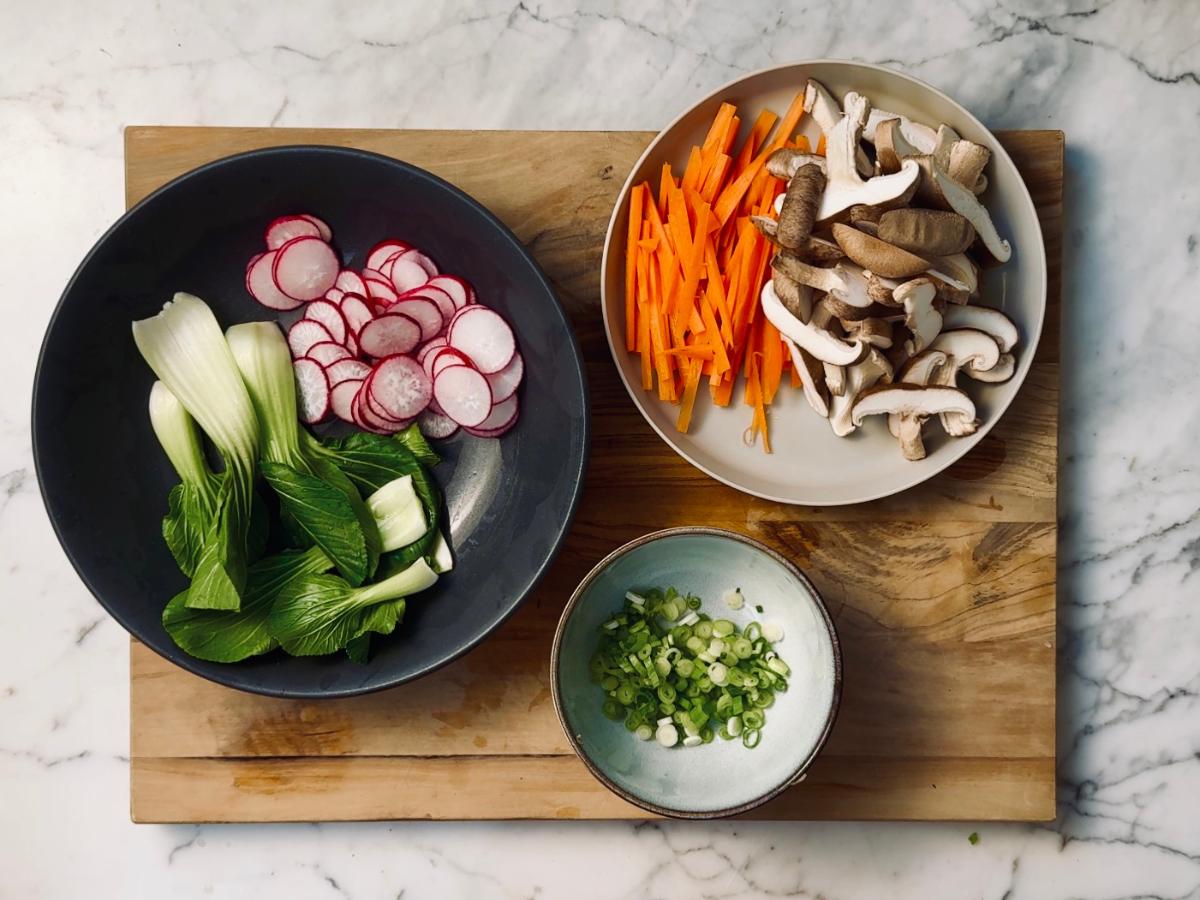
    Three bowls of prepared vegetables on a wooden chopping board: one with pak choy and thinly sliced pink radish, another with finely chopped spring onions, and a third with sliced mushrooms alongside julienned carrots.

    Instructions

    Make your Inari agé topping:

    Chopsticks dunking two aburaage (fried tofu sheets) in s shallow bowl of liquid, to prepare as a topping for vegan spicy ramen.

    1. Pour boiling water over the fried tofu sheets in a shallow bowl. Dunk them gently for a minute or so to remove any oil.

    Two hands squeezing liquid from aburaage (fried tofu sheets) over a colander and bowl to catch the excess, preparing the aburaage as a topping for vegan Japanese spicy ramen noodles.

    2. Then drain and rinse the tofu under cold water, using your hands to carefully squeeze out the excess moisture. 

    Aburaage (fried tofu sheets) simmering in dashi, sugar, and soy sauce in a saucepan over heat, to prepare it as a topping for vegan Japanese spicy ramen.

    3. In a medium saucepan, bring the dashi, sugar, and soy sauce to a gentle simmer. Add the tofu sheets and cook over medium heat for 10-15 minutes, allowing them to absorb most of the liquid without boiling.

    A knife slicing aburaage into 1-inch strips on a wooden chopping board to use as a topping for vegan Japanese spicy ramen.

    4. Turn off the heat and remove the tofu sheets. Let them cool, then slice into 1-inch strips with a sharp knife.

    Make your sesame paste

    White sesame seeds in a frying pan being gently toasted over heat.

    5. While you're simmering your tofu sheets - toast the sesame seeds in a pan until golden.

    White toasted sesame seeds being ground to a paste in a mortar and with a pestle.

    6. Once they're evenly golden, transfer them to a mortar and pestle and grind into a paste.

    Make your broth

    Two hands holding a garlic press, squeezing it to mince the garlic for vegan spicy ramen.

    7. Mince the garlic in a garlic press. Set aside.

    Grating fresh ginger over a chopping board to use in vegan Japanese ramen. A small dish of minced garlic sits on the edge of the board.

    8. Grate the ginger and set that aside with the garlic.

    Two hands dicing red onion finely on a wooden chopping board, one carefully holding a slice of the onion in place while the other chops with the knife.

    9. Finely dice the red onion.

    Chopped red onions frying in oil inside a saucepan over heat. A wooden spatula is in the pan to turn the onions as they cook.

    10. Heat the oil in a medium saucepan and fry the onion until golden.

    A saucepan over heat containing oil, chopped red onion and some seasonings. A wooden spatula is combining the mixture inside the saucepan.

    11. Add the garlic and ginger and fry for a further 2 minutes before adding the ground sesame seeds and sugar. Stir.

    Mixing a small bowl of miso paste with dubanjiang (spicy chili bean paste).

    12. Next, mix the miso and doubanjiang with a bit of hot water to create a smooth paste. Add this to the saucepan. 

    A saucepan over heat containing small chunks of minced garlic, onion and ginger in a yellow liquid of miso, dubanjiang (spicy chili bean paste) and water.

    13. Pour in the vegetable stock and vegan dashi, then bring to a gentle simmer. Season with salt and pepper, and keep warm over low heat.

    While your broth is simmering make your toppings:

    Shiitake mushroom being sliced on a wooden chopping board.

    14. Slice the shiitake mushrooms into 1cm strips.

    Freshly sliced shiitake mushrooms just added to a hot frying pan with oil. Small bubbles are forming around the mushrooms, indicating they've started to sizzle but are not yet cooked.

    15. Heat the sesame oil in a frying pan over high heat, then add the mushrooms and fry until they start to brown.

    A frying pan over high heat frying sliced shiitake mushrooms in a brown marinade sauce, with a wooden spatula above the mushrooms to turn them as they cook.

    16. Add mirin, soy sauce, and a touch of sugar, then fry for another minute until caramelized. 

    A large knife thinly slicing spring onions on a wooden chopping board.

    17. Chop the spring onions finely and set aside.

    Two hands thinly slicing a pink radish on a wooden chopping board; the right hand holds a knife while the left steadies the radish. A pile of radish slices are gathering on one side as they're chopped, with discarded tops and ends set aside nearby.

    18. Slice the radishes into thin discs.

    A person julienning a carrot on a wooden chopping board, holding a knife in their right hand and the carrot in their left. Thin carrot strips are neatly piled to one side, with a peeler resting nearby.

    19. Julienne the carrot by slicing it into even, matchstick-sized strips.

    A small bowl of thinly sliced spring onions beside a larger bowl of fresh pak choy leaves, all set on a wooden chopping board with a Japanese chopping knife off to the side.

    20. Wash and pat dry your pak choy leaves.

    Cook your noodles:

    A large pot over heat, containing boiling water and Japanese ramen noodles, being stirred by a pair of chopsticks.

    21. Next, cook the ramen according to the package instructions, but slightly undercook them - adding the hot broth soon will finish cooking them without causing them to be a little too soft or mushy.

    Two bowls each containing a portion of Japanese ramen noodles, freshly cooked and drained, ready to be covered in broth and toppings to serve.

    22. Drain and place the ramen into serving bowls. 

    Serve up:

    Two bowls of spicy ramen noodles in a vegan broth, topped with inari age, mushrooms, and fresh vegetable garnishes - pak choy, thinly sliced pink radish, spring onions and julienned carrots. A pair of chopsticks rests on the edge of each bowl.

    23. Pour the hot broth over the noodles and add the toppings inari age, mushrooms, and the veggies.

    A bowl of spicy ramen noodles in a vegan broth, topped with inari age, mushrooms, and fresh vegetable garnishes, finished with a splash of rayu chili oil.

    24. Add a drizzle of rayu chili oil over the top for a bit of heat, and then serve.

    Hint: Adjust the spice level to your taste - add more or less doubanjiang and chili oil depending on how much heat you like.

    Time saving tips:

    1. Transform your wait time: While your tofu sheets are simmering, use the time to prepare your broth and boil up water for cooking your noodles. Turning this waiting period into productive prep and cooking time helps you save valuable minutes.
    2. Instant Dashi - If you don't already have homemade vegan dashi on hand, you can save time by using kombu dashi powder instead. It's a quick and convenient way to add that essential umami flavor without the extra prep work.
    3. Opt for frozen ramen: Frozen noodles cook in just 30 seconds! Simply blanch them in boiling water, and as soon as they untangle from each other, they're ready to serve. It's a fast, no-fuss option that still delivers that satisfying slurp-worthy texture.

    Variations

    • Tempura - switch out your fresh veg toppings for fresh homemade vegetable tempura (recipe coming soon).
    • Protein boost - Add crispy tofu cubes or edamame for some extra protein.
    • Creamy ramen - Blend some unsweetened soy or oat milk into the broth to make it rich and creamy. 

    Storage

    For leftovers, store the broth and toppings separately from the noodles in airtight containers for up to 3 days. Reheat gently on the stovetop to serve, making sure each component is piping hot before serving. To maintain the best flavor and texture, prepare the fresh garnishes right before serving. 

    Top Tip

    If you prefer your veggie toppings cooked, you can pan-fry the carrot and pak choi in soy sauce, mirin, and sugar right before serving. I recommend a quick flash in a hot pan to lock in flavor while keeping some crunch. Check out our recipe for soy-seared pak choi, which works great for frying up any of your favorite vegetables.

    FAQ

    Where can I dind vegan dashi? 

    Check specialty Asian grocery stores or online retailers for vegan dashi powder or make your own kombu-based broth. For a simple homemade version, check out my vegan dashi recipe.

    How do I store leftover dashi broth? 

    Keep it refrigerated in an airtight container for up to 3 days or freeze for up to 1 month. 

    Can I make vegan spicy ramen that's gluten-free? 

    Yes, with a few minor adjustments. Use gluten-free soy sauce and swap ramen noodles for a gluten-free option such as rice noodles.

    Related

    Looking for other recipes like this? Try these:

    • yuzu ramen pictured from above
      Yuzu Ramen (Japanese Citrus Noodle Soup Recipe)
    • mabo eggplant on a bed of rice
      Mabo Nasu (Mapo Eggplant 麻婆茄子)
    • Our Favourite Vegan Udon Noodle Recipes
    • yaki udon noodles garnished with pickled ginger and spring onions
      Vegan Yaki Udon - Easy 25-Minute Stir-Fried Noodles
    See more Main dishes →

    Pairing

    Looking for some dishes to serve on the side of your ramen? Try these:

    • vegan fried chicken piled high on a small plate
      Vegan Fried Chicken
    • Close up of the beer and eggplant stir-fry served in a shallow bowl, garnished with spring onions.
      Beer and Eggplant Stir-Fry (10 Minute Recipe)
    • sticky tofu on a round plate garnished with spring onions and pickled ginger
      Sticky Tofu: Easy 10-Minute Recipe
    • sushi recipes poster
      Our Favourite Vegan Sushi
    See more Side dishes →

    📖 Recipe

    A bowl of spicy vegan Japanese ramen in a rich broth topped with inari age, shiitake mushrooms and fresh vegetables.

    Spicy Ramen

    This vegan spicy ramen brings deep umami flavors with miso, dashi, and chili bean paste-topped with mushrooms, inari age, and fresh veggies.
    Print Recipe Pin Recipe
    Prep Time 20 minutes mins
    Cook Time 20 minutes mins
    Course Main Course
    Cuisine Japanese, vegan, vegetarian

    Ingredients
      

    For the Inari Age

    • 2 abura-age (fried tofu sheets)
    • ⅓ cup vegan dashi
    • 2 ½ teaspoons sugar
    • 2 teaspoons soy sauce

    For the soup broth

    • 4 cloves garlic
    • 1 teaspoon ginger
    • 1 small onion
    • 1 ½ tablespoons toasted white sesame seeds
    • 2 tablespoons toasted sesame oil
    • 1.5 teaspoons doubanjiang (spicy chili bean paste)
    • 2 tablespoons miso paste
    • 1 tablespoon sugar
    • 1 tablespoon mirin
    • 2 teaspoons sake
    • 3.5 cups vegetable stock
    • 1 cup vegan dashi (or 1 cup water and 2 teaspoons kombu dashi powder)
    • 1 teaspoon salt
    • pinch of ground pepper
    • ¼ cup of hot water

    For the ramen noodles

    • 2 servings (1 serve = 100g of dry ramen or 200g fresh)

    For the mushroom topping:

    • 4-5 shiitake mushroom
    • 1 tablespoon sesame oil
    • 1 teaspoon mirin
    • 2 teaspoons soy
    • pinch of sugar

    For the garnish

    • 1 small carrot
    • 2-3 radishes
    • 2 pak choy leaves
    • 2 spring onions
    • rayu chili oil

    Instructions
     

    • Pour boiling water over the fried tofu sheets in a shallow bowl. Dunk them gently for a minute or so to remove any oil.
    • Then drain and rinse the tofu under cold water, using your hands to carefully squeeze out the excess moisture.
    • In a medium saucepan, bring the dashi, sugar, and soy sauce to a gentle simmer. Add the tofu sheets and cook over medium heat for 10-15 minutes, allowing them to absorb most of the liquid without boiling.
    • Turn off the heat and remove the tofu sheets. Let them cool, then slice into 1-inch strips with a sharp knife.
    • Toast the sesame seeds in a pan until golden.
    • Once they're evenly golden, transfer them to a mortar and pestle and grind into a paste.
    • Mince the garlic in a garlic press. Set aside.
    • Grate the ginger and set that aside with the garlic.
    • Finely dice the red onion.
    • Heat the oil in a medium saucepan and fry the onion until golden.
    • Add the garlic and ginger and fry for a further 2 minutes before adding the ground sesame seeds and sugar. Stir.
    • Next, mix the miso and doubanjiang with a bit of hot water to create a smooth paste. Add this to the saucepan.
    • Pour in the vegetable stock and vegan dashi, then bring to a gentle simmer. Season with salt and pepper, and keep warm over low heat.
    • Slice the shiitake mushrooms into 1cm strips.
    • Heat the sesame oil in a frying pan over high heat, then add the mushrooms and fry until they start to brown.
    • Add mirin, soy sauce, and a touch of sugar, then fry for another minute until caramelized.
    • Chop the spring onions finely and set aside.
    • Slice the radishes into thin discs.
    • Julienne the carrot by slicing it into even, matchstick-sized strips.
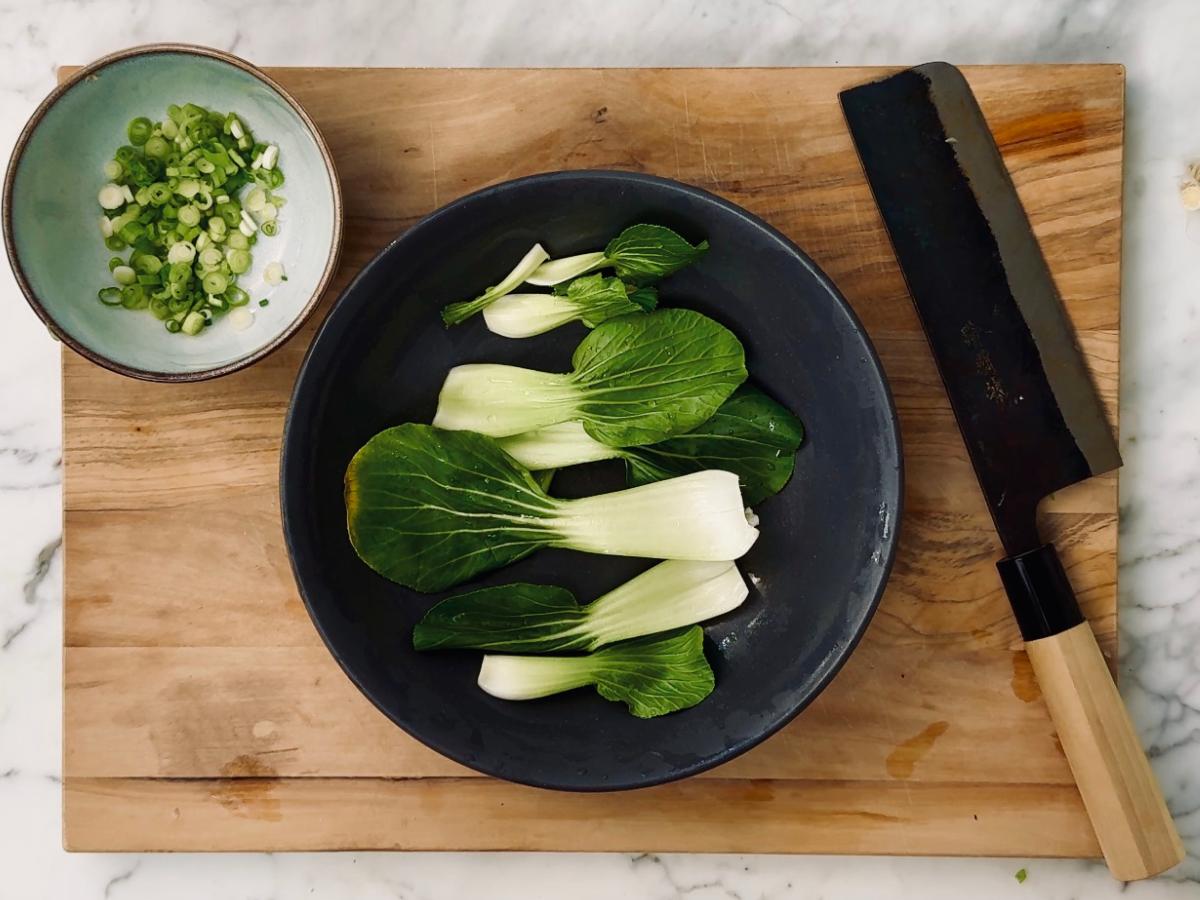
    • Wash and pat dry your pak choy leaves.
    • Next, cook the ramen according to the package instructions, but slightly undercook them - adding the hot broth soon will finish cooking them without causing them to be a little too soft or mushy.
    • Drain and place the ramen into serving bowls.
    • Pour the hot broth over the noodles and add the toppings inari age, mushrooms, and the veggies.
    • Add a drizzle of rayu chili oil over the top for a bit of heat, and then serve.
    Keyword easy dinners, easy lunch, fried tofu, healthy, Japanese mushrooms, noodle soup, noodles, ramen, spicy, vegetables

    More Noodles & Pasta

    • Curry udon noodles in a ramen bowl garnished with spring onions and choi sum leaves
      Curry Udon – Japanese Comfort in under 30 Minutes
    • a bowl of kake udon (thick udon noodles in a translucent soy based broth)
      Vegan Kake Udon (with Crispy Tofu Topping)
    • garnished with spring onions and japanese chilli powder; a bowl of spicy yaki udon noodles
      Spicy Yaki Udon – Easy 20-Minute Vegan Japanese Stir-Fried Noodles
    • miso mushroom pasta on a round ceramic plate garnished with shichimi togarashi spice and parsley
      Creamy Miso Mushroom Pasta (Vegan & Ready in 30 Minutes)

    Leave a Reply Cancel reply

    Your email address will not be published. Required fields are marked *

    Recipe Rating


    Aaron Zahl heads and shoulders photo in a cafe.

    Hi, we're Aaron and Jess!

    We love cooking vegan Japanese dishes and sharing tips for creating delicious recipes.

    Join us on this cooking adventure!

    More about us →

    Popular

    • miso walnut pesto spaghetti on a large ound plate. Garnished with thyme
      Miso Pesto, a Quick Umami Twist on Classic
    • vegan tofu recipes poster - a collage of 4 photos of finished tofu dishes. 1. agedashi, 2. sticky tofu, 3. kake udon, 4. tofu noodles - one image in each corner with graphic text overlayed which says "tofu recipes"
      Top 9 Vegan Tofu Recipes
    • japanese eggplant recipes thumbnail image
      Top 5 Japanese Eggplant Recipes
    • "rice recipes" writen in big bold font over a collage of rice dishes
      My Favourite Vegan Japanese Rice Recipes

    Footer

    ↑ back to top

    About

    • Privacy Policy
    • Terms & Conditions
    • Accessibility Policy

    Newsletter

    • Sign up

    Contact

    • Contact
    • Services

    Copyright © 2026 Vegan Japanese. All rights reserved.

    Manage Consent
    To provide the best experiences, we use technologies like cookies to store and/or access device information. Consenting to these technologies will allow us to process data such as browsing behavior or unique IDs on this site. Not consenting or withdrawing consent, may adversely affect certain features and functions.
    Functional Always active
    The technical storage or access is strictly necessary for the legitimate purpose of enabling the use of a specific service explicitly requested by the subscriber or user, or for the sole purpose of carrying out the transmission of a communication over an electronic communications network.
    Preferences
    The technical storage or access is necessary for the legitimate purpose of storing preferences that are not requested by the subscriber or user.
    Statistics
    The technical storage or access that is used exclusively for statistical purposes. The technical storage or access that is used exclusively for anonymous statistical purposes. Without a subpoena, voluntary compliance on the part of your Internet Service Provider, or additional records from a third party, information stored or retrieved for this purpose alone cannot usually be used to identify you.
    Marketing
    The technical storage or access is required to create user profiles to send advertising, or to track the user on a website or across several websites for similar marketing purposes.
    • Manage options
    • Manage services
    • Manage {vendor_count} vendors
    • Read more about these purposes
    View preferences
    • {title}
    • {title}
    • {title}
    Manage Consent
    To provide the best experiences, we use technologies like cookies to store and/or access device information. Consenting to these technologies will allow us to process data such as browsing behavior or unique IDs on this site. Not consenting or withdrawing consent, may adversely affect certain features and functions.
    Functional Always active
    The technical storage or access is strictly necessary for the legitimate purpose of enabling the use of a specific service explicitly requested by the subscriber or user, or for the sole purpose of carrying out the transmission of a communication over an electronic communications network.
    Preferences
    The technical storage or access is necessary for the legitimate purpose of storing preferences that are not requested by the subscriber or user.
    Statistics
    The technical storage or access that is used exclusively for statistical purposes. The technical storage or access that is used exclusively for anonymous statistical purposes. Without a subpoena, voluntary compliance on the part of your Internet Service Provider, or additional records from a third party, information stored or retrieved for this purpose alone cannot usually be used to identify you.
    Marketing
    The technical storage or access is required to create user profiles to send advertising, or to track the user on a website or across several websites for similar marketing purposes.
    • Manage options
    • Manage services
    • Manage {vendor_count} vendors
    • Read more about these purposes
    View preferences
    • {title}
    • {title}
    • {title}