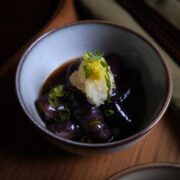
Eggplant Agebitashi (Nasu Agebitashi)
Eggplant agebitashi (nasu agebitashi) is a classic Japanese dish where fried eggplant is soaked in a savoury dashi marinade until tender and full of umami. This vegan version is topped with grated daikon, fresh ginger, and sliced green onions, and is traditionally served chilled or at room temperature as a refreshing Japanese appetizer or side dish.
Servings: 4
Calories: 151kcal
Ingredients
Fried Eggplant
- 250 g Japanese or baby eggplants
- 250 ml neutral oil for deep frying
Toppings
- 100 g daikon radish or white or pink radish
- 2 green onions scallions
- 3 cm fresh ginger
Broth / Marinade
- 250 ml vegan dashi
- 3 tablespoon mirin
- 3 tablespoon sake
- 3 tablespoon soy sauce
- 15 g sugar
Instructions
- Make the marinade: Place the vegan dashi in a small saucepan over medium heat. Add the mirin, sake, soy sauce, and sugar. Bring to a gentle simmer and stir until the sugar has dissolved. Simmer for a few minutes, then remove from the heat and set aside.
- Prepare the eggplant: Trim the tops and bottoms of the eggplants and slice them in half lengthwise. If using larger eggplants, cut them into pieces about 4 inches long and 1½ inches thick.
- Score the eggplant: Lightly score the skin side of each piece with shallow cuts about ⅛ inch (2–3 mm) apart. This helps the eggplant absorb the marinade.
- Heat the oil: Pour the neutral oil into a deep pan and heat to 160°C (320°F).
- Fry the eggplant: Carefully add the eggplant pieces to the oil and fry until tender and lightly golden. Do not overcrowd the pan. Fry in batches if needed.
- Drain the eggplant: Remove the fried eggplant and drain on a wire rack or paper towel.
- Marinate the eggplant: Transfer the eggplant to a medium glass container and pour the marinade over the top. Make sure most pieces are immersed in the broth.
- Let it soak: Allow the eggplant to marinate for at least 1 hour, or refrigerate overnight for deeper flavour.
- Prepare the toppings: Grate the daikon radish and ginger. Thinly slice the green onions into fine discs.
- Assemble the dish: Place 3–4 pieces of eggplant into a small bowl. Spoon over some marinade so the eggplant sits in a shallow pool of broth.
- Add the toppings: Top with a small mound of grated radish, a pinch of grated ginger, and a sprinkle of sliced green onions.
- Serve: Serve eggplant agebitashi chilled or at room temperature as a Japanese appetizer or side dish.
Notes
Use Japanese eggplant if possible
Japanese or baby eggplants have thinner skins and a more delicate texture, which allows them to absorb the marinade better. Italian eggplant can also be used, but cut it into smaller pieces.
Score the eggplant skin
Lightly scoring the skin helps the eggplant cook evenly and allows the marinade to soak in more effectively. Do not overcrowd the pan
Fry the eggplant in batches if necessary. Overcrowding lowers the oil temperature and can make the eggplant greasy instead of tender. Marinate while the eggplant is warm
Adding the marinade while the eggplant is still warm helps it absorb more flavour. This dish is traditionally served chilled
Eggplant agebitashi is often served cold or at room temperature rather than hot. It is a refreshing Japanese appetizer that works well as part of a larger meal. Leftover marinade is liquid gold
Do not discard it. It can be used to marinate tofu, season noodle bowls, or as a base for ramen broth. Make it ahead of time
This dish actually tastes better after resting for a few hours. The eggplant continues absorbing the marinade as it sits.
Lightly scoring the skin helps the eggplant cook evenly and allows the marinade to soak in more effectively. Do not overcrowd the pan
Fry the eggplant in batches if necessary. Overcrowding lowers the oil temperature and can make the eggplant greasy instead of tender. Marinate while the eggplant is warm
Adding the marinade while the eggplant is still warm helps it absorb more flavour. This dish is traditionally served chilled
Eggplant agebitashi is often served cold or at room temperature rather than hot. It is a refreshing Japanese appetizer that works well as part of a larger meal. Leftover marinade is liquid gold
Do not discard it. It can be used to marinate tofu, season noodle bowls, or as a base for ramen broth. Make it ahead of time
This dish actually tastes better after resting for a few hours. The eggplant continues absorbing the marinade as it sits.
Nutrition
Serving: 1 serve | Calories: 151kcal | Carbohydrates: 16g | Protein: 4g | Fat: 7g | Saturated Fat: 1g | Polyunsaturated Fat: 0.5g | Monounsaturated Fat: 6g | Sodium: 1065mg | Potassium: 311mg | Fiber: 3g | Sugar: 10g | Vitamin A: 77IU | Vitamin C: 8mg | Calcium: 40mg | Iron: 1mg
